
The capital is not a place you visit
The Xi’an Local Chronicles Office is direct about the situation: the great majority of Tang Chang’an’s remains lie pressed beneath the modern city, and the damage has been considerable. There is no preserved Tang capital to walk through.
What exists instead is a set of points — a gate, a market, a temple, a few ward sites, two pagodas — scattered through a city that grew over the top of the old one. Knowing that in advance changes what you plan.
How the city came to be there
The same account gives the origin. After founding the Sui dynasty, Emperor Wen decided to build a new capital on the south slope of Longshou yuan. Work began in 582 under the engineer Yuwen Kai, and the palace city and the imperial city were finished in about a year. In 583 the court moved in.
The new capital was named Daxing, after a title the emperor had held earlier. In 618 Li Yuan founded the Tang and renamed the city Chang’an. The chronicles office notes that the Tang capital largely inherited Daxing’s scale, layout and facilities, with partial expansion and improvement rather than a fresh design.
Two halves and one axis
Daxing was laid out symmetrically east to west, and the whole city was divided into two by a single central axis: Zhuque Avenue. The Tang kept that arrangement.
Within the outer wall sat three enclosures, one inside the other. The chronicles office records that remains of all three can still be traced — the palace city, the imperial city and the outer city — which is why the search for Tang Chang’an is mostly a search for edges and lines rather than buildings.
What you can still stand on
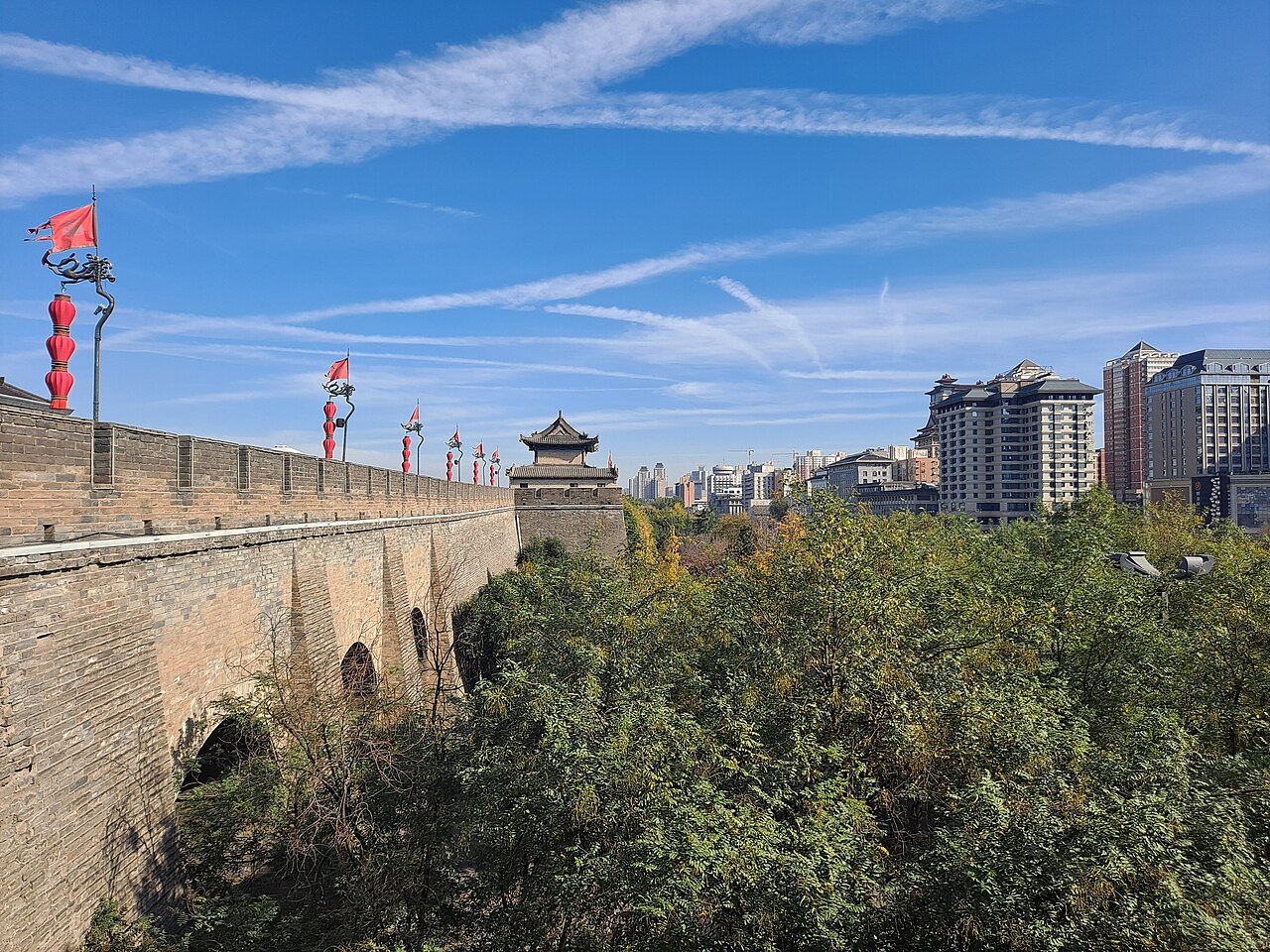
One of the more useful facts for a visitor is this: sections of Xi’an’s own west and south walls are Tang imperial city wall. The wall people walk today is Ming work, but parts of its line sit on Tang foundations rather than beside them.
Two major buildings do survive above ground. The chronicles office names them: the Big Wild Goose Pagoda and the Small Wild Goose Pagoda. Everything else of the Tang city that a visitor can see has been dug up, protected or re-presented.
The office lists what has been excavated and opened: the Daming Palace site, Qinglong Temple, Xingqing Palace, Daxingshan Temple and the Qujiang scenic area. Those are the places where the Tang city is legible on the ground, and each is a reconstruction of context around surviving evidence rather than an intact Tang street.
The sites, by name
The protected area is itemised in the chronicles, and the list is worth reading because it shows what archaeology has actually reached. It includes the Daming Palace site, the Hanyuan Hall site, the Taiye Pool site, Danfeng Gate, the Yuanqiu altar of Tang Chang’an, the Yanping Gate site, the West Market site, the Chonghua ward site, the Tongyi ward site, the Zhuangyan Temple site in Heping ward, and the Qujiang pool site.
Read that list carefully and the shape of the evidence appears: gates, an altar, a market, a temple, a pool and a handful of named wards. Not a city. The ward names survive as archaeological locations precisely because the wards themselves do not.
How any of this was established
The chronicles office records the sequence. In 1957 the Shaanxi Provincial Cultural Relics Management Committee surveyed the two site complexes, and the Institute of Archaeology of the Chinese Academy of Social Sciences excavated there repeatedly afterwards.
In 1996 the State Council listed the Sui Daxing and Tang Chang’an city sites in the fourth batch of national key cultural relics. Archaeological drilling across the area has broadly established the basic layout and extent, which is why the chronicles can describe the city’s boundaries against modern landmarks at all.
What to do with this
Treat the Tang capital as a route rather than a destination. Pick the points that interest you — a gate site, a market, a palace platform, a pagoda — and accept that you will travel through the modern city between them.
The chronicles office draws this account from the Xi’an city gazetteer, a record compiled after the fact from survey and excavation. Opening arrangements at the individual sites change with conservation work, so check with each site before travelling rather than assuming a fixed itinerary.