
Begin with the date, not the adjective
The main surviving circuit of Xi’an’s wall belongs to the Ming period. It is not the outer wall of the Tang capital and it was not built for Qin Shi Huang. Repairs, rebuilding and conservation are also part of the structure seen today.
That distinction is worth holding onto as you climb. Xi’an’s famous places represent different cities and different eras on the same plain. The wall helps you understand one of those cities especially well: an enclosed urban centre with gates controlling the routes through it.
A gate is a piece of the city’s organisation
From ground level, a gate can seem like a picturesque interruption to a road. From above, its role becomes easier to read. Streets approach the wall, traffic passes through designated openings, and the fortification separates inside from outside.
Look at the gate structures, the wall’s thickness and the relationship with the moat and approaches. Defence was not only about height. It was also about controlling movement and creating a boundary that could be watched and managed.
The view is historical and contemporary
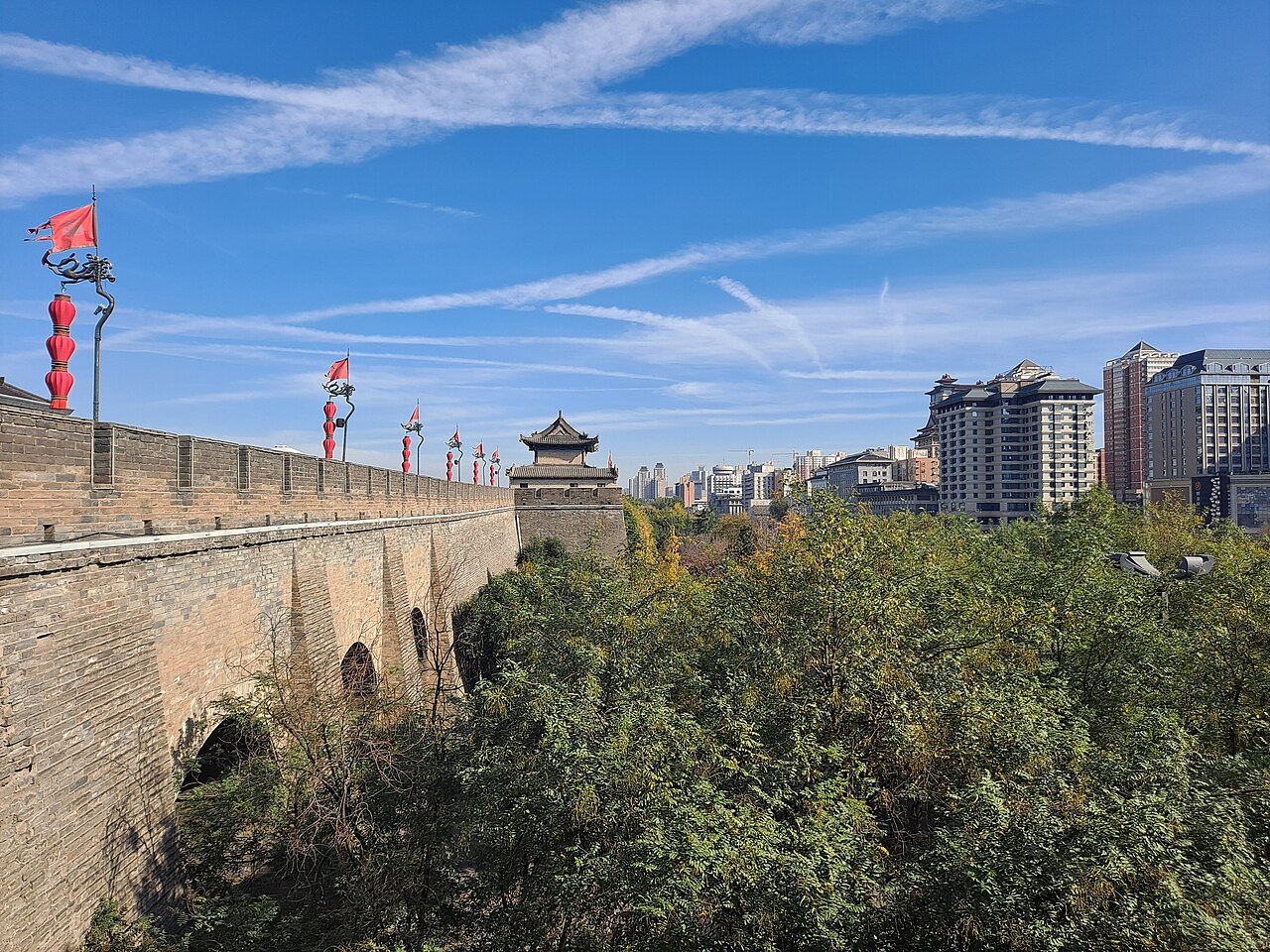
Turn towards the interior and then towards the modern city beyond. The contrast is not a simple division between ancient and new: modern life continues on both sides. What survives is a powerful outline within a city that has expanded far beyond it.
At street level around the wall, public spaces and everyday journeys now sit beside former military infrastructure. This is one reason to combine a short visit above with a walk below. The monument’s present use is part of the story, rather than a distraction from it.
Conservation is part of what you see
A long-standing monument does not survive without decisions about maintenance and use. Repaired masonry and managed visitor routes should not be mistaken for proof that every visible surface is unchanged from the Ming period. Preservation is an ongoing activity.
Similarly, a modern opening or visitor facility can serve today’s city without explaining the original defensive plan. Read the site’s interpretation when identifying individual structures. Broad labels such as “ancient wall” are an introduction, not a complete building history.
You do not need to complete the circuit
A short walk with time to pause can be more revealing than a fast circuit. Compare views at a gate and between gates; notice how the streets change as you move. If cycling, check the current rental conditions and keep your attention on the shared surface.
The top is exposed to the weather, and access points have their own arrangements. Check the open gates and your intended descent before setting off. Choose the length of visit to suit your group rather than using distance as the measure of success.