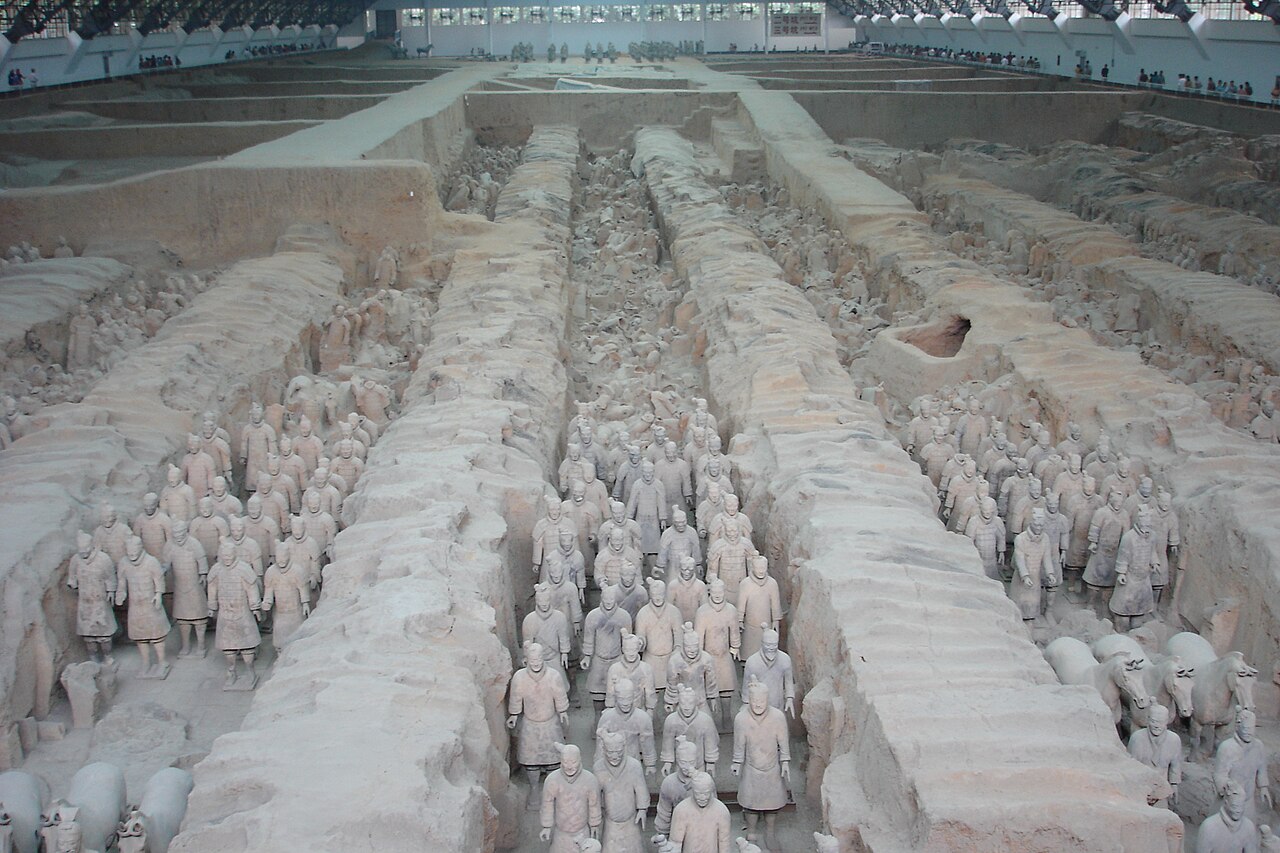

The grey was never the plan
The army in the pits at Lintong is grey. Grey was not the original finish. Research published by the Emperor Qinshihuang’s Mausoleum Site Museum establishes that the figures were coloured, and that the colour sat on a layer of raw lacquer applied over the fired clay.
That changes how you look at the site. What stands in the pits is not an army that was made plain. It is a painted installation that has lost its paint, and the loss is the more interesting story.
What the figures actually wore
The colours were not decorative guesswork. The museum describes faces, hands and limbs finished in pink, and hair, eyebrows, beard and eyes in black, with garments in a range of other colours.
Across the figures, the museum reports eight colours in close to twenty tones, from twelve different pigments. Most of those were minerals. A few were made by people.
The surviving traces name them: red from cinnabar and lead red, green from malachite, blue from azurite, white from bone white and lead white, and a purple that does not occur in nature at all.
The purple that had to be invented
Chinese purple is a barium copper silicate, and the museum states plainly that it is man-made. It has not been found in nature in a usable form; the museum describes it as a pigment first identified in China and prepared only there at the time.
It stayed in use until the end of the Han dynasty in 220 CE. The terracotta figures are the earliest objects using it whose excavation site and date are securely established. Purple on a figure was usually a blend of cinnabar and Chinese purple rather than one pigment on its own.
Why it disappeared so fast
The museum’s conservators describe what the paint sat on. Raw lacquer is an organic film, and underground it stayed in damp, sealed conditions. Brought into dry air, it loses water and shrinks.
Because that film is bonded to rigid fired clay, it cannot simply contract. Its edges lift away from the surface, buckle and curl, and take the pigment with them. Conservators in Xi’an describe the lacquer layer shrinking sharply and curling as it dries, detaching the whole painted layer from the figure.
There is a second effect worth knowing about. The bond between the paint and the surrounding soil proved stronger than the bond to the figure, so much of the colour came away onto the earth it had been buried in. Some of the best evidence survives as a stain in the ground.
Minutes, not centuries
The change is measured in minutes. Reporting from the conservation laboratory at Pit 1 describes extreme cases in which the pigment alters sharply within a few minutes of being uncovered, because it loses water quickly. Moisture retention and consolidation therefore have to be applied at once.
Two materials do that work. Conservators use polyethylene glycol together with a polyurethane emulsion, and separately a method of monomer impregnation followed by electron-beam polymerisation. The museum developed the approach with the Bavarian State Office for Monument Conservation in Germany.
What the laboratory does now
A conservation laboratory opened beside Pit 1 in 2024 so that newly lifted figures can be stabilised on site instead of being carried elsewhere. Work is done in temperature- and humidity-controlled, filtered air.
A colorimeter reads the surface every ten seconds and plots the result; a flat line means the colour is holding. An ultra-depth-of-field microscope records detail the eye misses, including what was reported as a craftsman’s fingerprint left on a figure more than two thousand years ago.
The remaining problem is not the lacquer but re-attachment. Stabilising the lacquer layer is solved; putting colour that has already separated back onto a figure is still a research problem, and no established method has been published for it.
What to look for in the pits
Visitors can see more painted material than in the past. The museum’s displays include painted heads and specific figures that carry surviving colour, among them the green-faced warrior and a figure with Chinese purple on its sleeve.
Read the modelling, not only the colour. Hair, topknots, armour plates and lacing, tunic folds, moustache and eyebrows were shaped in relief, and the paint was laid over that shaping. Where the paint has gone, the relief is what remains of a painted portrait.
Treat vivid colour photographs with caution. A photograph of a fully painted warrior standing in a pit does not exist, because exposure to the air in the pit is what destroyed the paint. The bright images in circulation are reconstructions built from pigment analysis.
Displays and access change as excavation and conservation continue, so the painted material on show can differ from one visit to the next. Check the museum’s current notice before you travel.